
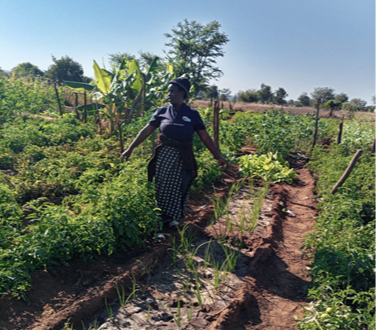
The saying, “Give a woman a little and she will multiply it,” aptly describes the determination and resourcefulness of rural women farmers. Across Africa, women transform limited resources into food, income and opportunities for their families and communities. They conserve seed, nurture the land, share knowledge and build livelihoods, often while carrying significant household and caregiving responsibilities.
Sithembile Mtetwa, a farmer from Chipinge District, Zimbabwe, embodies this spirit. Her journey demonstrates how women’s leadership, financial inclusion, agroecology and consistent reinvestment can strengthen food and seed sovereignty while building resilience to climate change. Sithembile was introduced to the Rural Women’s Assembly (RWA) through the Zimbabwe Farmers’ Union. She immediately recognized the Assembly as an important platform through which she and other rural women could organize, learn and collectively challenge structural barriers affecting their access to productive resources and economic opportunities.
“I started with very little, guided by a vision to improve my family’s future. I used income from the sale of farm produce, together with returns from my local Village Savings and Lending Association, to invest gradually in my farming enterprise,” she explains.
Through disciplined saving and careful reinvestment, Sithembile mobilized resources to improve her farm’s water infrastructure. This became increasingly urgent as climate change contributed to unreliable rainfall and recurring water shortages in Chipinge. She successfully drilled a borehole, installed a water-storage tank and established an irrigation system serving her one-hectare garden. Access to reliable water transformed her production. It reduced her dependence on seasonal rainfall and enabled her to grow food throughout the year. This investment strengthened her household’s resilience to climate-related shocks while improving the availability of diverse and nutritious food.
Today, Sithembile’s garden supports a diversified agricultural enterprise. She produces traditional vegetables, onions, leafy greens, tomatoes, sweet potatoes for both vines and tubers, and other high-value crops. She has also established fruit trees, further diversifying production and creating longer-term benefits for household nutrition, environmental restoration and income generation. Her farming approach reflects the RWA pillars of agroecology and food sovereignty. Through crop diversification, the production of locally adapted foods and the responsible use of available land and water, she is strengthening her household’s ability to determine what it grows and eats. Her work also highlights the importance of preserving traditional crops and farmer knowledge in building food systems that are nutritious, culturally appropriate and resilient.
For Sithembile, farming is not only about producing for the market. It is also about ensuring that families have access to sufficient, healthy and diverse food. By growing traditional vegetables and multiplying sweet-potato vines, she contributes to the local availability of planting materials and nutritious foods. This supports seed sovereignty by reducing farmers’ dependence on expensive external inputs and strengthening community control over locally appropriate crops. Sithembile has also used agricultural income to diversify beyond farming. Building on the success of her garden, she opened a utility shop at the local township. The shop provides an additional income stream and demonstrates how earnings from agriculture can be reinvested in complementary enterprises. This diversification protects the household against production and market shocks while strengthening its economic security.
Her achievements extend beyond her household. As a flagship farmer, Sithembile actively shares her skills and practical experience with other farmers in her ward. Guided by the principle of “each one, teach one,” she encourages women to save, invest strategically, diversify production and adopt climate-resilient farming practices.
Her farm has become a practical learning site where other women can see how small, consistent investments can generate lasting change. By openly sharing both her knowledge and experience, Sithembile strengthens collective learning and solidarity central principles of the Rural Women’s Assembly movement. Her journey also shows why rural women need access to finance, land, water, farmer-managed seed systems, markets and platforms for collective action. When these resources and opportunities are available, women can lead the transition towards equitable, sustainable and climate-resilient food systems.
Sithembile’s story is not simply about individual success. It illustrates the wider transformative potential of investing in rural women and their organisations. Her progress has improved household food security, diversified income, strengthened climate resilience and created learning opportunities for other women. From a small beginning, she has built a thriving farm, secured water for year-round production, diversified into business and become a source of knowledge and inspiration within her community. Sithembile truly multiplies what she receives turning limited resources into food, dignity, resilience and opportunity for others.


Pingback: Assemblee Des Femmes Rurales D’Afrique Australe Bulletin D’Information Aout 2026 – Rural Women's Assembly