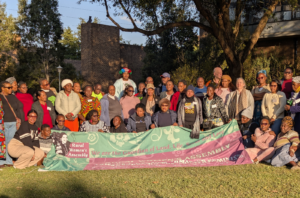
The Rural Women’s Assembly is a movement of peasants, small scale farmers, farmworkers and fisher women in 11 countries in Southern Africa. It is a membership based movement. It is good to see many RWA comrades here but also see Isabelle here today, she participated at our first convening in 2009. Every planting season, women in our villages wake up before dawn, bodies still tired from tilling the land. Our members like thousands of Rural Women labour tirelessly under the scorching sun, sowing maize, cassava, pearl millet, sorghum, cowpeas, or peanuts, each season , each year they hope the harvest will be better and they will have money from the sale of their produce to send children to college , repair leaking roofs, or at least have some money for improving their plots and homesteads. from the uncertainties of farming. But season after season, they find themselves trapped in a cycle of struggle, earning barely enough to survive.
Women farmers and peasants form the backbone of small-scale agriculture, household food security are the seed guardians and yet they remain the least rewarded, they remain the most marginalised. Their efforts are frustrated by exploitative middlemen, sexual harassment, unstable markets, limited access to credit, and restrictive trade policies that lock them out of more feasible opportunities and their contributions are generally overlooked. Middlemen buy produce at throwaway prices, only to resell it at significantly higher rates, leaving farmers with meager earnings. Women farmers, often lacking direct access to markets, are at the mercy of these brokers who control supply chains. However, there are also other constraints such as poor infra-structure (roads) local markets are not able to provide enough facilities and good systems for storing food etc.
An Africa Union study indicate that middlemen underpay rural women farmers by 30-50% below market value, keeping them economically vulnerable. In addition to market exploitation, rural women struggle to access financial support to expand their farms. Women also face other problems in that their land size is mostly smaller than their male counter -parts, FAO), women receive less than 10% of available agricultural credit, limiting their ability to purchase inputs, have transport and irrigation equipment. They lack of collateral, restrictive banking policies, and financial illiteracy further hinder their ability to secure funding, leading to lower yields and poor crop quality. It is clear that the current macroeconomic structure is gender-blind. Not only does it not value women’s role in the food system, it has continued to be shaped and underpinned by colonial, patriarchal and neoliberal legacies.
Across Africa, food systems are undergoing rapid and far-reaching change. In fact it is viewed as the avenue for “fast and quick” investments. Already Supermarkets are expanding into urban centres, processed foods are becoming more widely available, and agribusinesses are scaling up production for export and formal markets. This expansion is also tied to advertising of fast food chains as a model and better (and the youth are getting drawn into this narrative). Currently, food processing dominates The International Finance Corporation (IFC) arm of the World Bank – agricultural investments in Africa. Out of 54 total agricultural projects in sub-Saharan Africa disclosed from 2019 to 2024, 50 were food related. However, a close look at these investments shows that many of the investee projects are either export-oriented (like cocoa projects) or are intended to serve domestic markets but provide limited nutritional value (like soft drink companies). DFIs now fund and promote a model of agriculture based on industrial inputs, export crops, supermarket expansion, and private equity-led agribusiness. These investments are justified in the name of development and productivity, but the reality on the ground tells a different story.
DFI financing is reinforcing systems that concentrate power and marginalise the very people these funds are meant to support. Smallholder farmers, informal traders, and Indigenous communities are being left behind, while public money is used to expand the reach of global agribusiness, processed food industries, and formal retail chains. CEDAW General Recommendation 17 calls on States to recognize the economic and social value of unpaid domestic and care work and to reflect that value in national statistics and public policy. Trade justice involves rethinking contemporary understandings of “development” with a renewed emphasis on public expenditure to support domestic productive sectors and diversify local economic activities.
Under the dominant neoliberal and export-oriented development model, which is marked by legally binding constraints on advancing industrial policy within trade and investment agreements, Global South economies are disarticulated into low-value-added, labor-intensive and dependent modes of commodity, raw material and “cash crop” production created by the unjust legacies of colonialism. Access to support or finances from a bank also implies having “collateral” this has meant to shift from land with “user rights titles” on land to the demand for sale of land and private property. Other challenges such as Contract farming initiatives, where agribusiness firms engage directly with women farmers, does not ensure fair pricing and market security, instead it turns the women farmers/ peasants into farm hands on their own land.
Way Forward
It is clear that we require greater control over the food system and the types of investment deals that are now coming into Africa.
Empowering rural women farmers is not just about food security—it is about economic justice, social equity, and unlocking the full potential of Africa’s agricultural economy.
Economic/ trade literacy
Investment in appropriate technology (simple and inexpensive)
Investment and Capacity enhancement in value addition of local products.
Municipalities have to be geared to improve local onfra-structure and markets.