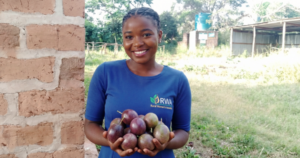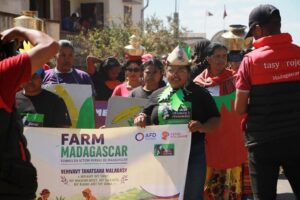
During this month, the Namibia Rural Women’s Assembly (NRWA) visited members across the Erongo Region to assess progress, understand the challenges they continue to face, and document stories of resilience and success. The visits also connected rural women with local language radio stations, providing them with a platform to share their experiences, challenges and achievements in their own voices.
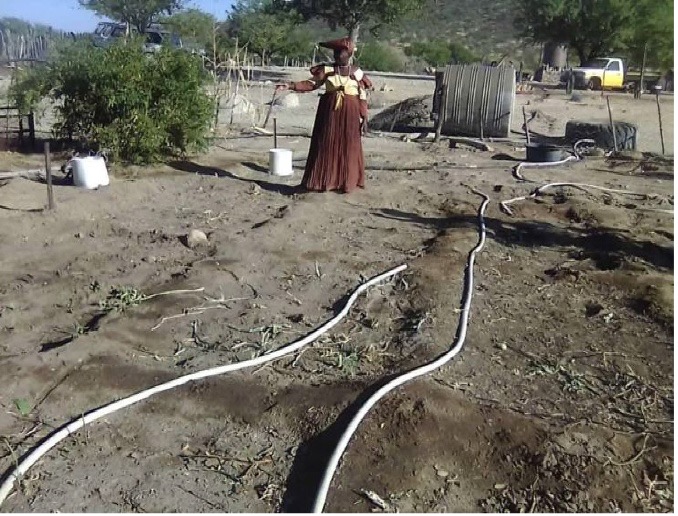
Among the many inspiring stories, one stood out. It is the story of Ms Tiire Tuamanovandu Tjindjo, a 70-year-old rural woman farmer from Otjozondjou Village, Daures Constituency, Erongo Region. Her journey reflects the courage, determination and resilience of many rural women who continue to produce food for their families despite enormous challenges.
On 15 January 2023, elephants entered her homestead and destroyed her vegetable garden, damaged her water infrastructure and wiped-out months of hard work in a single night. Her cabbage, spinach, carrots, onions, grapevines, guava, papaya and moringa were destroyed, leaving only a single hot chilli plant standing. Sadly, Tiire was not the only victim. During that same week, several other women in the Otjohorongo Communal Area also lost their backyard gardens to elephant destruction.
For many rural women, a home garden is more than a source of food. It is a family’s supermarket, a source of income, and a symbol of dignity and self-reliance. When elephants destroy these gardens, families lose not only crops but also their ability to feed themselves and earn an income.
The destruction left more than physical damage. It left deep emotional scars. For almost a year and a half, Tiire lived in trauma and fear. She was afraid to rebuild because she believed the elephants would return and destroy everything again. Like many rural women living in elephant corridors, she faced the difficult question of whether it was worth investing her time, labour and scarce resources only to lose everything overnight.
When she finally found the courage to plant again, another challenge emerged. The crops were slow to establish and the production was poor. Tiire believes this may have been linked to the elephant urine she found throughout the garden after the destruction, which she felt may have affected the condition of the soil. Although this has not been scientifically confirmed, it reflected what she observed in her field. She refused to give up. Little by little, the soil recovered, the vegetables began to grow again, and her confidence slowly returned.
As an organic farmer, Tiire has continued to strengthen her farming system using natural production methods that protect the soil and the environment. She has also introduced lucerne as a sustainable source of fodder for her small livestock, improving her farm’s resilience while reducing dependence on purchased feed.
Today, her garden is flourishing once again. It provides healthy food for her family, produces surplus vegetables for sale and stands as a living example that resilience, determination and hope can overcome even the greatest setbacks.
Her journey has been strengthened by the support of the Namibia Rural Women’s Assembly (NRWA). Through seed distribution, farmer-to-farmer learning visits, encouragement, training and community mobilisation, NRWA has supported many rural women across the region to rebuild their gardens, restore household food production and regain confidence after devastating losses.
Communities have also benefited from the support of Elephant Human Relations Aid (EHRA), which donated flashlights to help improve safety during elephant movements at night. While this support is deeply appreciated, it also highlights a painful reality: despite reporting the damage and having it assessed, many affected families received no practical assistance to restore their livelihoods. Much of the direct support has come from civil society organisations while rural women continue to bear the greatest burden of human-elephant conflict.
A Call to Action
By Agnes Tengovandu Tjindjo, Erongo Regional Coordinator, Namibia Rural Women’s Assembly (NRWA)
Tiire’s story reflects the reality faced by many rural women across Erongo Region and Namibia. Human-elephant conflict is no longer only a conservation issue. It is a food security, livelihoods and rural development issue. Rural women continue to lose gardens, water infrastructure and income, yet they are too often excluded from the decisions that affect their lives.
The Namibia Rural Women’s Assembly calls upon the Government of Namibia to place rural women at the centre of all policies and decisions concerning human-wildlife conflict, food security and climate resilience. Women living alongside wildlife possess valuable knowledge and practical experience that should guide national policies and community-based solutions.
We further call for greater investment in community-based prevention rather than relying only on emergency responses after damage has already occurred. Rural communities need practical training on affordable, locally appropriate and sustainable methods of protecting their homes, gardens and water infrastructure from elephants. Families should be equipped with preventative measures that reduce elephant incursions instead of only chasing elephants away for one night. Too often, officials respond after an incident, communities chase the elephants away, the officials return to their offices, and within days the elephants are back, destroying gardens once again. This cycle must end.
We also call upon the Omatjete Greater Elephant Committee to revitalise and strengthen its representation by ensuring that communities most affected by human-elephant conflict are meaningfully represented. Rural women, farmers and residents living within the elephant corridor must have a seat at the table because they experience these challenges every day. Decisions about managing human-elephant conflict should be guided by the lived experiences of those on the frontline. A committee that genuinely reflects affected communities will be better positioned to develop practical, inclusive and sustainable solutions that protect both people’s livelihoods and wildlife.
The Namibia Rural Women’s Assembly believes that lasting solutions can only be achieved through genuine collaboration between government, conservation organisations, traditional authorities, community structures and the people living alongside wildlife. Rural women are not asking to choose between conservation and their livelihoods—they are asking to be recognised as equal partners in building solutions that allow both people and elephants to coexist safely and sustainably
‘’Tiire’s rebuilt garden is more than a personal success story. It is a symbol of the resilience of rural women across Namibia. But resilience alone is not enough. It is time for policy to match that resilience with action. The future of food security depends on the women who produce it, and those women deserve protection, recognition and a permanent seat at the decision-making table.’’
“My garden was destroyed in one night, but my hope was not. Today, I feed my family again because I chose to plant again.”
Tiire Tuamanovandu Tjindjo, Otjozondjou Village
When rural women thrive, families thrive. When families thrive, communities prosper.