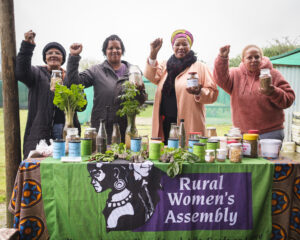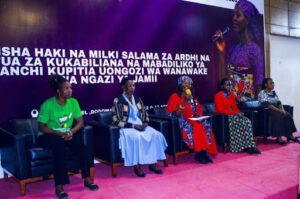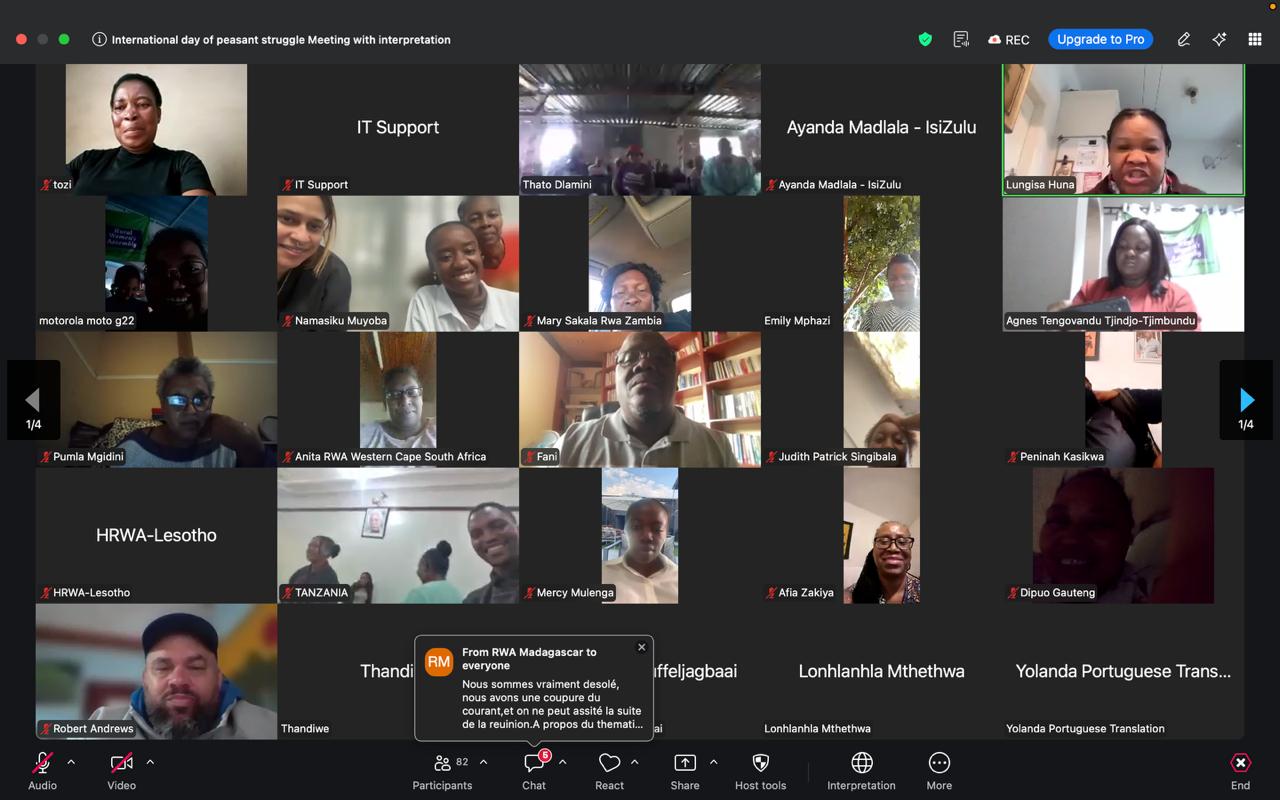
The Rural Women’s Assembly, in collaboration with the Trust for Community Outreach and Education (TCOE), convened a regional webinar to commemorate the International Day of Peasant Struggles, bringing together a powerful collective of rural women, activists, and allies across Southern Africa. The webinar created a dynamic platform for reflection, solidarity, and advocacy on issues of land, seed sovereignty, food systems, and the implementation of the United Nations Declaration on the Rights of Peasants (UNDROP). With over 500 women participating from 10 countries i.e. Zambia, Zimbabwe, Malawi, Namibia, South Africa, Eswatini (Swaziland), Lesotho, Mozambique and Madagascar, the dialogue reflected both the scale and urgency of the struggles faced, as well as the strength of organised rural women leading the call for justice, dignity, and transformative change. Missed it? Here are the key takeaways from our speakers of the webinar:
Commissioner Philile Ntuli – South African Human Rights Commission
Land, Food Systems, and Structural Inequality
Commissioner Philile Ntuli delivered a deeply reflective and politically grounded presentation that situated hunger and food insecurity within broader historical, structural, and systemic injustices. Speaking from both an institutional and lived perspective as a woman, she challenged dominant narratives that treat hunger as a natural or inevitable condition.
She began by confronting a critical misconception, stating clearly that:
“Hunger… is not just an accident. It is a result of political as well as economic choices.”
This framing set the tone for her intervention, shifting the discussion away from charity or food aid, and toward accountability and systemic transformation. The Commissioner emphasised the stark contradiction that defines many African food systems today She explained that this paradox is rooted in deeply entrenched inequalities, where access to food is determined not by availability, but by income, power, and structural exclusion. In this context, hunger becomes a symptom of injustice rather than scarcity.A significant portion of her presentation unpacked the historical foundations of this crisis. She traced current food insecurity back to colonial land dispossession and apartheid spatial planning, which disrupted indigenous relationships with land, food, and knowledge systems::
“We are a continent that produces more than enough food, yet millions of us still go hungry.…..The relationship between people, land, and nourishment was profoundly altered and disrupted.”
She further highlighted that these disruptions were not only economic but also cultural and spiritual, eroding systems of care, biodiversity, and indigenous knowledge that had sustained communities for generations. Commissioner Ntuli placed strong emphasis on the role of women within food systems, noting that rural women are central to food production, seed preservation, and household nutrition. Yet, despite this, they remain among the most food insecure:
“Rural women… grow, harvest and sustain food systems, yet we are ourselves amongst the most food insecure.”
She identified this as a structural injustice, beyond a gender issue, stressing that inequality within food systems actively contributes to hunger.Turning to contemporary dynamics, she highlighted the growing concentration of power within food systems:
“Power in the food system is highly concentrated… a handful of corporations dominate inputs, processing and retail.”
She shared that this concentration excludes small-scale producers and shifts food systems away from public good toward profit-driven models, which are inherently incompatible with food justice. She also underscored the centrality of land in achieving food sovereignty, pointing out that without secure access to land and water, rural women cannot meaningfully participate in food production:
“Food sovereignty is not a slogan… it is a demand for redistribution of power.”
In addition, she addressed the intensifying impact of climate change, noting that those least responsible, particularly rural women farmers and fishers, are bearing the greatest burden, often without adequate support or adaptation resources. A key insight from her presentation was the distinction between policy existence and implementation. While legal frameworks such as the right to food exist, she stressed that:
“What we are facing is not only a crisis of access… it is a crisis of accountability.”
Drawing from the South African Human Rights Commission’s recent inquiry into food systems, she shared that testimonies revealed a system “designed” to be unequal, reinforcing the idea that meaningful change requires confronting underlying power structures. Importantly, the Commissioner rejected narratives that position rural communities as passive recipients of aid. Instead, she affirmed that:
“Rural women are already building alternative food systems… grounded in agroecology, community control, and collective knowledge.”
These systems, she argued, are not marginal but represent viable and necessary pathways toward food sovereignty.
She concluded with a powerful call to action directed at institutions, governments, and movements alike. Emphasising the need for a shift in power, she stated:
“If we are serious about the right to food, then we must move beyond managing hunger towards transforming the systems that produce it.”
In closing, she reaffirmed the political agency of rural women:
“Rural women are not merely beneficiaries… we are political actors, organisers, and knowledge holders.”
Raffaele Morgantini – CETIM (Centre Europe – Tiers Monde, Geneva)
UNDROP, Corporate Power, and Global Accountability
Raffaele Morgantini’s presentation brought a critical international dimension to the webinar, connecting grassroots struggles in Southern Africa to global systems of power and accountability. Speaking from his position at CETIM, a Geneva-based human rights organisation, he situated peasant struggles within the broader context of corporate dominance and international law. He began by highlighting the central role of transnational corporations (TNCs) in shaping global food systems, noting that their influence extends across the entire agricultural value chain:
“In the current dominant economic systems, transnational corporations play a dominant role in food and agricultural systems.”
He explained that these corporations exert monopolistic control over inputs, seeds, processing, and distribution, fundamentally shaping who benefits from food systems and who is excluded. This concentration of power, he argued, directly impacts the rights and livelihoods of peasants and rural communities:
“Their activities have a direct impact on the rights of rural communities, peasants, and other people working in rural areas.”
Raffaele made it clear that the violations experienced by rural communities land dispossession, seed control, and exploitation are systemic outcomes of corporate-driven models of development. These violations, he stressed, are in direct contradiction with international human rights standards, particularly those enshrined in the United Nations Declaration on the Rights of Peasants (UNDROP). He emphasised that while UNDROP provides a strong normative framework, it is not sufficient on its own to regulate corporate power. This led to one of his central arguments:
“The effective regulation of transnational corporations in international law is an essential premise for the implementation of UNDROP.”
In this regard, he introduced the ongoing global process to develop a UN Binding Treaty on Transnational Corporations and Human Rights, describing it as a crucial tool to address corporate impunity. He explained that this treaty aims to establish legal obligations for corporations, accountability mechanisms and sanctions for human rights violations. He explained that achieving such a binding instrument would represent a significant step toward protecting peasant rights:
“A robust and effective binding treaty… will create the conditions for better protection of the rights recognised in UNDROP.”
He stressed that UNDROP and the Binding Treaty are not separate processes, but deeply interconnected:
“These two legal frameworks… are deeply intertwined and should be jointly promoted to reinforce each other.”
This insight underscored the importance of a dual advocacy strategy i.e. one that simultaneously advances local implementation of UNDROP while engaging in global negotiations to regulate corporate power. Raffaele also grounded his presentation in specific provisions of UNDROP, demonstrating how they can be used as practical tools for resistance and advocacy. He highlighted Article 17 (Right to Land) as a critical mechanism for communities facing land dispossession:
“Peasants can claim this right to land… against any attempt to evict them from their territories.”
He explained that this article can also be used to push governments toward meaningful agrarian reform, positioning land not just as an economic asset, but as a human right. Turning to Article 19 (Right to Seeds), he addressed the growing control of seeds by corporations through intellectual property regimes:
“A small number of transnational corporations have monopolistic power over agricultural seeds.”
He noted that this creates significant barriers for peasants who rely on traditional seed systems. However, UNDROP provides a counter-framework:
“Peasants can use this right as leverage to counteract this neoliberal offensive against traditional seeds.”
Raffaele also drew attention to state obligations under UNDROP, particularly the responsibility to regulate corporate activity and ensure that trade and investment agreements do not undermine human rights:
“States are responsible for ensuring that transnational corporations respect human rights.”
This, he argued, is especially important in the context of free trade agreements, which often prioritise corporate interests over community rights. Throughout his presentation, Raffaele repeatedly returned to the importance of solidarity and collective action across scales. He emphasised that local struggles must be linked to global advocacy spaces, particularly within the United Nations system:
“We need to stand together, we need to unite, and we need to articulate efforts both at national and international level.”
Despite technical interruptions during his presentation, his message remained clear and urgent: that confronting corporate power requires coordinated, multi-level strategies that bridge grassroots movements and international legal frameworks. He concluded by reaffirming CETIM’s commitment to supporting movements like the Rural Women’s Assembly in both arenas, noting ongoing efforts to develop tools such as position papers and fact sheets to strengthen advocacy.
Dr. Fani – Trust for Community Outreach and Education
Land Reform and Agrarian Justice in Southern Africa
Historical Land Dispossession and the Failures of Land Reform
Dr. Fani’s presentation provided a deeply analytical and historically grounded examination of land dispossession in Southern Africa, with a particular focus on South Africa. His contribution connected past injustices to present-day inequalities, making it clear that the land question remains central to understanding food insecurity, poverty, and rural marginalisation.
He began by situating land dispossession within a broader political economy, drawing on the work of scholar Samir Amin to explain how Southern Africa functioned as a “labour reserve” under colonialism:
“Land dispossession was used to boost capitalist development… and to destroy indigenous land use practices.”
Through this lens, he explained that land was not only taken from African communities but that entire systems of living, production, and social organisation were dismantled. Communities were forcibly removed from productive land and relocated into overcrowded and under-resourced areas, fundamentally altering how people lived and produced food.
“People were taken out of the land and forced into overcrowded areas that were reserved for them.”
These areas, often referred to as homelands or Bantustans, continue to shape present-day rural realities. Dr. Fani emphasised that the legacy of these spatial injustices is still visible today in patterns of overcrowding, land degradation, and limited access to productive land.
Turning to post-apartheid efforts, he critically assessed the land reform programme introduced in 1994. While the programme initially aimed to redistribute 30% of agricultural land within five years, he pointed out that progress has been extremely slow and uneven:
“Less than 2% had been redistributed by the year 2000.”
He explained that over time, the focus of land reform shifted away from benefiting the poor toward models that favoured elite beneficiaries and commercial interests. This shift undermined the transformative potential of land reform and excluded many of those most in need, particularly women, farm workers, and rural dwellers.
“The programme moved from a pro-poor approach to an elite beneficiation approach.”
Dr. Fani also highlighted how partnerships between the state and white commercial farmers often resulted in the latter becoming the primary beneficiaries of land reform initiatives:
“White farmers and consultants became the actual beneficiaries… controlling funds and drawing profits.”
As a result, land reform not only failed to redistribute land equitably but also reinforced existing power structures within the agricultural sector. Three decades later, he noted that land ownership patterns remain largely unchanged:
“White people still own the majority of land… while women own only a small fraction.”
He drew particular attention to the gendered dimensions of land inequality, emphasising that women despite being central to food production remain significantly excluded from land ownership. A key strength of Dr. Fani’s presentation was his detailed analysis of the social and economic consequences of failed land reform. He described how overcrowding in rural areas has led to increasing tensions within communities, competition for limited land, conversion of grazing land into housing and conflict between livestock owners and crop producers. He explained that these pressures disproportionately affect women, who are often pushed out of productive land:
“Women are pushed out of the fields and restricted to backyard gardens.”
This shift has profound implications for food production and household food security, as backyard gardening cannot replace larger-scale cultivation. Dr. Fani also described how the scarcity of grazing land leads to livestock encroaching on arable land, further undermining agricultural productivity:
“Livestock roam freely and prevent the use of land for cultivation.”
Farmers are forced to invest in fencing to protect their crops, yet these efforts are often undermined by ongoing land pressures and conflict. This cycle contributes to declining food production, increased food prices, and deepening rural poverty.
He linked these economic challenges to broader social impacts, including rising levels of distress and vulnerability in rural communities:
“This situation contributes to poverty… and even social crises such as suicides linked to economic hardship.”
In addition to these internal pressures, Dr. Fani warned of growing external threats to rural land rights, particularly from mining companies and industrial agriculture:
“Land grabs by mining companies and industrial agriculture threaten to reverse even the limited gains made.”
He emphasised that without secure land tenure and strong protections for smallholder farmers, these processes will continue to displace communities and erode livelihoods. Despite the depth of these challenges, Dr. Fani concluded on a note that emphasised the importance of continued struggle and collective action:
“It will take a sustained struggle by strong land and peasant movements for the state to address these issues.”
Tozi Mthiyane, Coastal links (Umgababa, KZN)
We are Fisherwomen
Tozi Mtiane’s intervention brought an important and often underrepresented perspective into the webinar that of small-scale fisher communities. Speaking as a fisherwoman from KwaZulu-Natal, she grounded her contribution in lived experience, reminding participants that struggles for land, food, and resources extend beyond the soil to include oceans, rivers, and coastal ecosystems.
She introduced herself with an assertion of identity and experience:
“I am a small-scale fisher… I have been fishing for many years, even from a young age.”
Her words reflected a deep generational connection to fishing as both a livelihood and a way of life. Fishing, in her context, is not simply an economic activity; it is tied to culture, survival, and community identity.
Tozi highlighted the increasing pressures faced by small-scale fishers, particularly the ways in which access to water resources is being restricted and controlled. She pointed to the growing monopolisation of rivers and marine spaces:
“Our rivers are being monopolised.”
This statement captured a broader reality where access to natural resources is increasingly shaped by external forces whether through regulation, commercial interests, or environmental degradation often excluding the very communities that depend on them.
She also drew attention to the impacts of climate change on fisher livelihoods. Changing weather patterns, unpredictable water conditions, and environmental degradation are making it more difficult for small-scale fishers to sustain themselves:
“Climate issues are affecting us as fisher people.”
From her sharing we take that fisher communities, much like smallholder farmers in Southern Africa, are on the frontlines of climate change despite contributing the least to its causes. Yet, they often lack the support, recognition, and resources needed to adapt.
Another important dimension of her contribution was the gendered nature of these challenges. As a fisherwoman, Tozi’s presence itself challenged dominant narratives that often overlook women in fishing communities. Her voice highlighted the need to recognise and support women’s roles within these spaces, which are frequently invisible in policy and decision-making. Her contribution powerfully expanded the conversation beyond land to include water and marine resources as critical components of food systems and peasant struggles. It reinforced the idea that food sovereignty must also include aquatic ecosystems and the rights of those who depend on them.
Josephine Sharar – Maasai Women’s Land Rights and Disability Justice (Kenya)
Land Ownership, Gender, and Disability
Josephine Sharar delivered one of the most deeply personal and powerful contributions of the webinar, grounding the discussion of land rights in lived experience. Speaking as a Maasai woman with a disability, she brought forward an often invisible dimension of land struggles: the intersection of gender, culture, and disability. She began by situating land within the Maasai worldview, emphasising that land is not merely an economic asset but a foundation of life itself:
“In Maasai culture, land is not just property. It is life. It is identity, security, and survival.”
However, she explained that despite this central importance, Maasai women are systematically excluded from land ownership. Traditionally, women do not own land directly but access it through marriage:
“Women traditionally do not own land… they access land through their husbands.”
This dependency already places women in a vulnerable position, as their access to land is conditional and insecure. But for women with disabilities, Josephine explained, the situation becomes even more severe. She spoke candidly about the stigma faced by women with disabilities in her community, where harmful cultural beliefs associate disability with misfortune:
“Women with disability are excluded from marriage due to harmful beliefs… seen as a curse or a bad omen.”
As a result, many women with disabilities are denied marriage altogether—and with it, the primary pathway through which women access land. This exclusion leaves them without recognised rights to land, deepening their marginalisation:
“Without marriage, they have no recognised access to land.”
Josephine further described how cultural expectations around gender roles reinforce this exclusion. In Maasai communities, roles such as livestock management and physically demanding tasks are highly valued, and women with disabilities are often perceived as unable to fulfil these roles:
“They are seen as unable to fulfil these roles, which further marginalises them.”
This perception not only limits their participation in community life but also reinforces the idea that they are undeserving of land or resources. She highlighted the devastating consequences of this layered exclusion. Many women with disabilities become entirely dependent on their families for survival:
“Most of these women depend entirely on their parents… but what happens when their parents are no longer there?”
This question underscored the long-term vulnerability faced by these women, who often have no safety net, no land, and no independent means of livelihood.
Josephine also pointed to the role of limited access to education in perpetuating these inequalities:
“They see it as a waste to educate a woman with disability… they don’t see a future for this person.”
Without education, many women are unable to fully understand or claim their rights, even where legal frameworks exist. This creates a cycle of exclusion that is difficult to break. Despite these challenges, her presentation was not only a reflection of injustice but also a call to action. She urged participants to confront harmful cultural norms and push for inclusive policies:
“We must challenge harmful cultural beliefs that exclude and stigmatise women with disability.”
She called for land policies that recognise the rights of all women, regardless of marital status or physical ability, and linked these demands to international frameworks such as UNDROP and the rights of indigenous peoples. Importantly, she emphasised that land rights are not just about ownership, but about dignity and justice:
“Land ownership is not just property… it is about dignity, equality, and justice.”
She concluded with a powerful appeal for inclusion:
“Let us ensure that no woman is left behind.”
Lonhlanhla – Rural Women’s Assembly (Eswatini/Swaziland)
Grassroots Mobilisation and UNDROP Advocacy in a Non-Signatory Country
Lonhlanhla’s presentation offered a powerful example of grassroots organising in a context where the state has not formally adopted the United Nations Declaration on the Rights of Peasants (UNDROP). Speaking from Eswatini (Swaziland), she demonstrated how rural women are actively using UNDROP as a tool for mobilisation, awareness, and advocacy despite the absence of formal government commitment. She began by acknowledging the structural challenge facing rural women in her country:
“Swaziland is a country which has not signed UNDROP… which becomes a big challenge for rural women farmers and seed savers.”
This lack of formal recognition creates significant barriers, particularly around land access and seed sovereignty. She explained that in Eswatini, women face systemic exclusion from land ownership, and there is no comprehensive land policy that secures their rights:
“As we don’t have a land policy in the country, women can’t access land.”
Similarly, the absence of a seed policy that protects indigenous seed systems has left rural women vulnerable to the influence of multinational seed companies:
“We don’t have a seed policy that promotes and protects our indigenous seeds.”
Despite these constraints, Lonhlanhla’s presentation was deeply rooted in action and resistance. She described how rural women have taken ownership of UNDROP as an organising tool, beginning with making it accessible to communities:
“We have been able to translate UNDROP into our local language, Siswati, so our members can easily access it.”
This translation process was technical and political. By localising the language of rights, rural women were able to engage more meaningfully with the content and connect it to their lived realities. She outlined a range of grassroots strategies that have been implemented to build awareness and mobilise communities:
- Door-to-door civic education
- Community meetings and group discussions
- Formation of local clusters for organising
- Engagement with traditional leaders and structures
“We conduct door-to-door civic education… unpacking the declaration and how it impacts their lives.”
Through these efforts, UNDROP has been transformed from a global document into a living tool for community organising. Lonhlanhla also highlighted their strategic engagement with government and political structures. Despite facing resistance and delays, rural women have continued to push for dialogue and accountability:
“We have visited the Prime Minister’s office… and engaged the Ministry of Agriculture.”
She described the persistence required in these engagements, noting that government officials often delay or avoid meetings:
“Sometimes they don’t honour our invitations… or make us wait only to say the person is not available.”
Yet, rather than discouraging the movement, these challenges have strengthened their resolve. Rural women have expanded their advocacy by targeting multiple entry points, including Members of Parliament, municipal structures, development officers and Traditional authorities.
“We formed clusters where members lobby their own Members of Parliament.”
She also shared plans for collective action, including organising marches to demand recognition and implementation of peasant rights. A key insight from her presentation was the alignment between UNDROP and existing national frameworks. Despite Eswatini not signing the declaration, she noted that many of its principles are already reflected in the country’s constitution:
“Our constitution is more or less like UNDROP… especially on the right to land, water, and seeds.”
This provides an important advocacy opportunity using national legal frameworks to push for the practical realisation of rights that are already recognised in principle. Throughout her presentation, Lonhlanhla emphasised the central role of women as seed savers and custodians of indigenous knowledge. She warned that the growing influence of multinational seed companies is eroding traditional food systems:
“Our indigenous seeds have proven for decades that they are drought resistant… but they are being replaced.”
Her intervention highlighted the urgency of protecting these systems, not only for cultural preservation but also for climate resilience. She concluded by expressing appreciation for the role of the Rural Women’s Assembly in strengthening the accessibility of UNDROP:
“We thank RWA for simplifying UNDROP… making it easier for communities to understand.”
Agnes – Rural Women’s Assembly Namibia (UNDROP Coordinator)
From Awareness to Action – Localising UNDROP in Namibia
Agnes delivered a grounded and practical presentation that demonstrated what it looks like to move UNDROP from a global declaration into lived community practice. Speaking as the UNDROP Coordinator in Namibia, she reflected on both the progress made and the challenges faced in translating rights into reality for rural women.
She began by positioning herself within the broader struggle:
“I speak on behalf of Namibia Rural Women’s Assembly, representing rural women who are at the frontline of the struggle for land, seeds and dignity.”
Her presentation highlighted a deliberate and strategic approach to implementing UNDROP at the national level, beginning with building partnerships. She acknowledged the role of the United Nations Development Programme (UNDP) in supporting this work:
“We approached UNDP and requested partnership to make sure that awareness and implementation of UNDROP is happening.”
With this support, the RWA Namibia team initiated awareness campaigns across multiple regions, including Erongo, Kunene, Omusati, Omaheke, and others. However, Agnes emphasised that the approach was not about simply disseminating information but also it was about grounding UNDROP in the lived realities of rural women:
“We used approaches that are accessible and grounded in people’s realities.”
Central to this process was the use of local languages, which proved to be one of the most effective strategies:
“Our awareness was not in English… we made sure to use local languages in every region.”
This decision enabled deeper understanding and participation, allowing rural women to connect the principles of UNDROP to their everyday experiences of land access, water scarcity, and seed protection.
Agnes described how awareness sessions were designed as interactive and participatory spaces, not one-way communication platforms. Through community dialogues, workshops, and peer learning, rural women were able to reflect on their realities and begin articulating their own demands:
“We created safe spaces… not only for learning, but for reflecting and organising.”
A critical step in their approach was ensuring that these community voices did not remain isolated at the grassroots level. Agnes explained how the team intentionally created a bridge between communities and decision-makers:
“These demands were not left at community level… they were shared with local leaders and relevant authorities.”
This was achieved through stakeholder engagement meetings, where rural women’s demands were directly presented to government officials and policymakers. This process marked an important shift from awareness to advocacy.
However, Agnes was candid about the challenges encountered in this work. One of the most significant barriers identified was the lack of awareness of UNDROP among government officials themselves:
“In many interactions, we found that some officials are not familiar with UNDROP at all.”
This raised a critical question that she posed during her presentation:
“How do we implement what is not known? How do we protect rights that are not understood?”
This gap between global commitments and local institutional knowledge remains a major obstacle to implementation.
She also highlighted ongoing structural challenges faced by rural women in Namibia, including insecure access to land, water scarcity, limited participation in decision-making and weak policy uptake
“While UNDROP exists, its impact is not yet fully felt on the ground.”
Despite these realities, Agnes emphasised that the work is ongoing and evolving. She outlined several key areas of continued action:
- Strengthening grassroots awareness
- Building confidence among rural women to speak out
- Sustained engagement with government institutions
- Increasing visibility of UNDROP across platforms
“We continue to act… strengthening awareness and building confidence among rural women.”
A particularly powerful aspect of her presentation was the emphasis on learning and adaptation. Drawing from Namibia’s experience, she shared key lessons that can guide other countries in advancing UNDROP:
First, she stressed the importance of starting at the grassroots:
“When rural women understand their rights, they begin to demand.”
Second, she highlighted that engagement with government requires persistence:
“It requires patience, persistence, and continuous engagement.”
Finally, she emphasised the importance of translating global frameworks into local realities:
“UNDROP must be translated into local realities… both for communities and government.”
She concluded with a strong and hopeful message that captured both the challenge and the potential of this work:
“UNDROP is a powerful tool, but its strength depends on whether it is known, understood, and implemented.”