
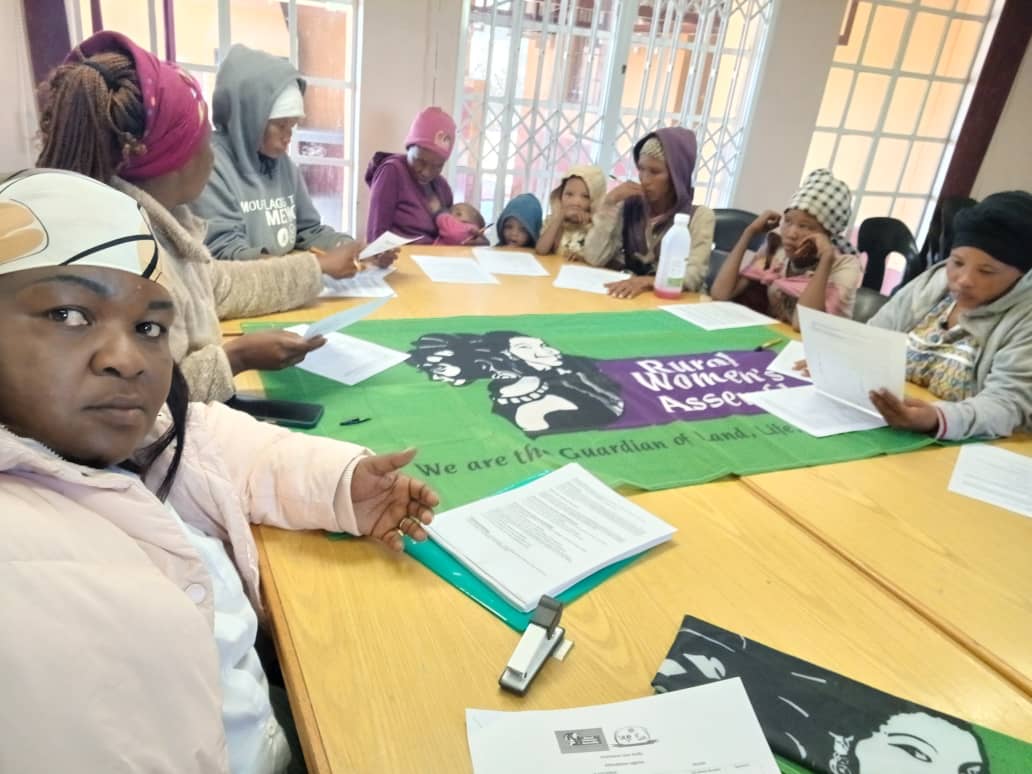
Listening to the voices of communities in Namibia’s Omaheke Region
The heat is no longer something rural communities simply talk about as part of the natural rhythm of life. Across the Kalahari, people are experiencing changes that are becoming increasingly difficult to ignore. Longer and more intense periods of heat are placing pressure on people, livestock, water, food systems and the natural environment.
It is against this reality that the Namibia Rural Women’s Assembly (NRWA) engaged communities in the Omaheke Region to document their experiences and knowledge around heatwaves.
The study took place in three different communities situated within the Kalahari area of Omaheke Region and brought together the experiences of San, Herero and Setswana-speaking communities. These communities have different histories, cultures and languages, but share a deep relationship with the Kalahari landscape and many of the challenges created by its harsh and changing climate.
This case study is therefore not simply about extreme temperatures. It is about people, knowledge, nature and survival. It asks what happens when a landscape that has sustained communities for generations begins to change, and what can be learned from the people who know that landscape best.
THE KALAHARI: A LANDSCAPE OF KNOWLEDGE AND SURVIVAL
The Kalahari is a vast sandy region extending across Namibia, Botswana and South Africa. In Namibia, the Kalahari Basin covers much of the eastern part of the country, with the Omaheke Region forming part of this Kalahari landscape along Namibia’s eastern border with Botswana.
For people living in the Omaheke communities covered by this study, the Kalahari is not an empty desert. It is home. It is where families raise livestock, collect plants, gather food, build their homes and maintain cultural practices passed from one generation to another.
The environment has taught people how to survive in conditions of heat, dryness and limited water. Over generations, communities have developed detailed knowledge of the plants, animals, soils, seasons and resources around them.
That knowledge is particularly important in a changing climate.
WHEN HEAT BECOMES A THREAT
Extreme heat affects much more than physical comfort. For rural communities whose livelihoods depend heavily on livestock, farming and natural resources, heat can threaten the very foundations of household resilience.
The study explored how people experience heat in their homes and farms and how they respond using knowledge and materials available within their surroundings.
Community practices investigated through the study included the use of cow dung on home walls, the management of thatched roofs, the positioning of food and water within the household and traditional approaches to protecting livestock from extreme heat.
These practices are important because they show that rural communities have not been passive in the face of harsh environmental conditions. They have developed ways of adapting using local resources and knowledge.
Yet the increasing pressure of climate change raises a difficult question: Will these practices continue to be enough as heat becomes more intense and environmental conditions continue to change?
THE KNOWLEDGE OF THE LAND
Perhaps the most powerful part of the study is the knowledge surrounding indigenous plants.
For generations, people in these communities have depended on plants not only for medicine, but also for food, livestock fodder, firewood, building materials and other household needs.
The study documented knowledge of a range of indigenous plants, including Otjihangatene, known as Devil’s Claw, Omujapu, Omandembere, Omungundi, Omusejasetu and Omumbonde or camelthorn.
For communities living in a harsh environment, such plants can represent much more than natural vegetation. They form part of a local system of food, health, livestock production and household survival.
Omujapu, for example, was recorded as having edible fruit, while its leaves and twigs provide important dry-season forage for livestock. Other plants documented through the study have traditional medicinal uses, while trees such as Omusejasetu are associated with livestock, construction and traditional healing practices.
This knowledge represents generations of observation and experience.
It is knowledge that has been built through living with the land.
WHEN A MEDICINAL PLANT DISAPPEARS, KNOWLEDGE DISAPPEARS WITH IT
One of the most concerning messages emerging from this case study is the threat to indigenous plants and the knowledge connected to them.
Some medicinal and indigenous plants that communities have traditionally known and used are becoming increasingly difficult to find, and there is growing concern that some may disappear from the environment altogether.
This is where the climate crisis becomes more than a question of temperature.
When rising temperatures, drought, changing rainfall patterns, environmental degradation and other pressures affect plant species, they can also affect the knowledge systems built around those plants.
When a plant disappears, we risk losing knowledge about where it grows, when it should be harvested, which part is traditionally used, how it is prepared and what role it has played in community life.
The loss of a plant can therefore become the loss of a piece of culture.
And when elders who hold this knowledge are no longer able to pass it on, the loss can become permanent.
WOMEN CARRY KNOWLEDGE
This is why rural women must be at the centre of discussions about climate change and indigenous knowledge.
Women are often closely connected to household food systems, water, livestock, agriculture, traditional medicine and the passing of knowledge to children and younger generations.
Their knowledge is often practical and deeply rooted in daily life.
A woman may know which plant can be collected during a particular season, which tree provides useful fodder, which materials can be used around the home, or which traditional practice has helped a household cope with difficult environmental conditions.
Much of this knowledge is rarely written down.
It lives in memory, practice and storytelling.
The heatwave study therefore provides an important opportunity to bring some of this knowledge into public attention while recognising that it belongs to the communities who have protected and carried it for generations.
RECOMMENDATIONS: TURNING KNOWLEDGE INTO HEATWAVE ACTION
The Omaheke experience shows that documenting heatwaves is only the beginning. The knowledge gathered from communities needs to be translated into practical action that can help women, families, livestock keepers and communities protect themselves as temperatures rise.
NRWA recommends that community awareness on heatwave self-protection becomes a regular part of rural climate and health education. Women, families, farmers and young people need accessible information on recognising the dangers of extreme heat, reducing unnecessary exposure, staying hydrated, protecting children and older people, managing outdoor work and seeking assistance when heat-related illness occurs.
The information must be communicated in local languages and through channels that rural communities can easily access and understand. Awareness should not be limited to written information. Community meetings, local radio, schools, women’s groups and farmer networks can all become important platforms for sharing heatwave information.
NRWA also recommends the development of simple heatwave awareness brochures and postcards that can be distributed in rural communities. These materials should use clear language and practical messages about heat exposure, hydration, protection from direct sunlight, care for vulnerable household members and livestock, and when to seek medical attention.
The postcards and brochures could also document real community experiences of heatwaves and their effects, allowing people to see that extreme heat is not simply an environmental issue but something that can affect health, livelihoods, livestock, food systems and household wellbeing.
PROTECTING WOMEN’S SKIN AND HEALTH
Particular attention should be given to women’s health and skin protection during periods of extreme heat.
Communities should be encouraged to be cautious about using commercial products or substances on the skin when their ingredients, safety or suitability under intense heat and sun exposure are unknown. Heat, prolonged sun exposure and certain products may contribute to skin irritation or other problems.
Rather than promoting untested products, NRWA recommends documenting the traditional and locally available organic materials that communities already use for skin and body care, while working with appropriate health and scientific experts to assess their safety and suitability.
This can create a bridge between indigenous knowledge and scientific research.
DOCUMENTING ORGANIC AND INDIGENOUS HEAT-PROTECTION PRACTICES
A dedicated community documentation process should be established to record plants, natural products and traditional practices that communities associate with protection from heat and sun, including practices used for the skin, body, household and livestock.
The documentation should capture the knowledge of elders, traditional knowledge holders, women farmers and other community members who understand these practices. It should record the local name of each plant or product, where it is found, which part is traditionally used, how it is prepared, how it is applied or used, and what community members understand its purpose to be.
Where a plant or product is traditionally used for skin protection or other health purposes, this information should be clearly distinguished from scientifically established medical claims.
This is important because traditional use is valuable knowledge, but it should not automatically be presented as proof of medical effectiveness or safety.
The documentation should therefore create opportunities for appropriate researchers, health professionals and knowledge holders to work together to assess promising practices while respecting community ownership of indigenous knowledge.
RECORDING WHAT HEATWAVES ARE DOING TO COMMUNITIES
NRWA also recommends creating a community-based record of heatwave experiences.
Photographs, oral histories, short testimonies, drawings and community stories can help document what extreme heat looks like in people’s everyday lives. This could include changes in livestock behaviour, impacts on crops and gardens, effects on water availability, damage to plants, challenges experienced by women and children, and other changes observed by communities.
These records can become an important community archive and can also support future advocacy for stronger climate adaptation measures.
FROM AWARENESS TO COMMUNITY PREPAREDNESS
Awareness must ultimately lead to preparedness.
NRWA recommends that rural communities develop simple, locally appropriate heatwave preparedness measures that identify who may need additional support during periods of extreme heat and how communities can respond.
Women’s groups can play an important role in sharing information, identifying vulnerable households, protecting community knowledge and supporting local preparedness.
The same community structures that already organise around food security, agriculture, livestock and climate resilience can become part of a broader community heatwave response system.
THE KALAHARI IS SPEAKING
The heatwave study in Omaheke is ultimately a story about listening.
Listening to San, Herero and Setswana-speaking communities.
Listening to rural women.
Listening to elders.
Listening to farmers and livestock keepers.
And listening to the land itself.
The communities of the Kalahari are telling us that the environment is changing and that knowledge which has sustained people for generations cannot be taken for granted.
Some plants are becoming harder to find. Some knowledge is at risk of disappearing. And the pressures of a changing climate are making the protection of both increasingly urgent.
The time to document, protect and pass on indigenous knowledge is now.
Because when we protect the plants, we protect biodiversity.
When we protect biodiversity, we protect livelihoods.
When we protect indigenous knowledge, we protect culture.
And when we place rural women at the centre of climate action, we strengthen the resilience of entire communities.
THE KALAHARI IS NOT EMPTY.
IT IS A LIVING LANDSCAPE OF PEOPLE, PLANTS, KNOWLEDGE AND CULTURE.
ITS FUTURE DEPENDS ON WHETHER WE LISTEN, LEARN AND ACT.
Namibia Rural Women’s Assembly (NRWA)
Amplifying rural women’s voices. Protecting indigenous knowledge. Building resilient communities.
