Introduction
In Eswatini, the right to food is under siege, while the country’s fertile soils and rich traditions of seed preservation should guarantee food security, corporate monopolies and policy neglect have created a system where rural women and small-scale farmers struggle to survive. The Swaziland Rural Women’s Assembly (SRWA) has taken this fight for land dispossession, and the erosion of food sovereignty. This newsletter is highlighting the challenges faced by rural communities, the grassroots alternatives being built, and the urgent recommendations for policy change and global solidarity.
Corporate Control Over Food Systems
Eswatini’s food system is shaped by policies that favor corporate interests over community needs. The absence of a seed policy that will protect traditional seed policy and secure land tenure on Swazi Nation Land has opened the door to corporate land grabbing. Without protection, rural farmers and especially women lose access to the very resources that sustain their livelihoods.
Monopolies in Agriculture
Multinational corporations dominate Eswatini’s agricultural landscape. Illovo controls the sugar industry, Montigny dominates forestry, and processed food markets are flooded with imports. These monopolies displace small-scale farmers, erode local food systems, and concentrate wealth in the hands of a few. Corporate agribusinesses thrive on exploitation where workers face low wages, hazardous conditions, and environmental degradation. Commercial farms through contract farming deplete soils, leaving communities with barren land. The promise of “development” through corporate agriculture has instead deepened poverty and inequality.
Government’s Famer Input Subsidies (FISP) is depending on hybrid seeds which is another tool of control. Farmers pay a sum of Six thousand emalangeni(E6000) equivalent to $350 for these subsidies every year on these hybrids and this dependency undermines traditional seed systems, erodes biodiversity, and traps farmers in cycles of debt while also increasing the use of fossil fuel in food systems.
Barriers to Food Sovereignty
Eswatini’s policies fail to protect agroecology, traditional seed preservation, or local food markets. Without legal recognition, community-led practices remain vulnerable, the state’s silence on food sovereignty perpetuates corporate dominance as these corporates have money to also market their seeds on all available media in the country.
Most fertile land is controlled by the monarchy or leased to corporations while smallholder farmers are pushed to marginal lands, limiting their ability to produce food for their families and communities. Land inequality is not just an economic issue it is a violation of human rights. Supermarkets prioritize imported goods, sidelining local producers. This undermines rural economies and erodes cultural food traditions. Consumers are left with expensive, foreign products while local farmers struggle to find markets for their produce.
Women Resistance
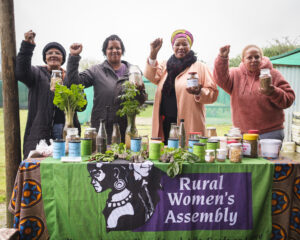
Despite these challenges, rural women are building powerful alternatives like seed sharing platforms from communities to the region and traditional food preservation practices are keeping local knowledge alive. Agroecology through crop rotation, organic farming, and soil regeneration offers sustainable pathways to food security. These practices are rooted in community resilience and ecological balance.
Communities are resisting land dispossession through legal battles. Cases in Vuvulane, Sigombeni, Bulembu and other individual women who has fearlessly defended their land highlight the courage of rural people who refuse to be silenced. These struggles are not just about land they are about dignity, survival, and justice but land cases drag and take time to be finalised obstructing women from continuing producing and ensuring food sovereignity. Women’s stokvels (savings groups) and cooperatives sustain local food systems. By pooling resources, women create safety nets that protect families from hunger and economic shocks. These solidarity economies embody feminist principles of care, cooperation, and collective power.
Recommendations
SRWA gathered and developed a draft contribution to the UN call for on food systems to protect human rights and prevent climate harm and recommended the following:
- Swaziland should sign the UN Declaration on the Rights of Peasants (UNDROP) to protect small farmers.
- Swaziland should develop a land policy with antimonopoly laws to curb corporate monopolies.
- Support traditional seed systems and invest in agroecology research.
- Regulate agribusinesses to prevent land grabs and environmental harm.
- Ensure fair wages and safe working conditions in plantations.
- Government should fund community-led initiatives such as seed banks and agroecology training.
This Matters because the right to food is not just about any food but is about justice, dignity, and sovereignty. When corporations control seeds, land, and markets, they control life itself. Rural women in Swaziland are demanding a system where food is produced sustainably, distributed fairly, and rooted in local traditions. our struggle is part of a global movement across Africa and the world, communities are resisting corporate power and reclaiming food sovereignty. SRWA’s actions against corporate power amplifies these voices, reminding us that the fight for food is the fight for freedom.
6. A Call to Action
The challenges are immense, but so is the resilience of rural women. SRWA calls on allies locally and globally to stand in solidarity, whether through policy advocacy, funding grassroots initiatives, or amplifying rural voices, every action counts. Food sovereignty is not a distant dream it is being built every day in seed-sharing circles, agroecology farms, and women’s cooperatives. With the right support, these alternatives can transform Eswatini’s food system into one that nourishes both people and planet.
Conclusion
Eswatini’s food system is at a crossroads. Corporate power threatens to entrench inequality and hunger, but grassroots resistance offers a path toward justice. The Swaziland Rural Women’s Assembly has made its case clear: the right to food must be protected, and food sovereignty must be prioritized. Together we can dismantle corporate control and build food systems rooted in sovereignty, solidarity, and sustainability.