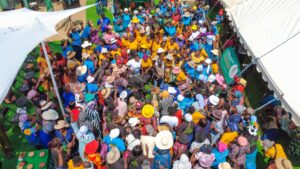
Across rural communities in Namibia, women continue to feed families, preserve indigenous knowledge and protect the seeds that have sustained generations. Through the work of the Namibia Rural Women’s Assembly, women participating in community demo seed multiplication plots successfully planted and harvested mahangu, cowpeas and bambara groundnuts, demonstrating resilience, leadership and a deep connection to land despite difficult climatic conditions.
This season’s demo seed multiplication plot was a trial, but its impact has been powerful. It created an opportunity for women to practically test indigenous seed production, strengthen seed preservation and learn through hands-on experience. What began as a small initiative quickly became a space of learning, solidarity and hope. Women worked collectively to prepare the land, plant, weed, monitor the crops and harvest, sharing knowledge and strengthening practices that have been carried through generations.
The successful harvest is more than a farming achievement. It reflects women’s labour, determination and commitment to food sovereignty. The harvest of mahangu, cowpeas and bambara groundnuts has contributed to household food supplies while also ensuring seed is saved for the next planting season. This strengthens local seed systems and allows communities to continue producing crops that are well adapted to Namibia’s climate and environment.
Women participating in the demo plots spoke with pride about what the harvest represents beyond food production. Many reflected on how they grew up watching parents and grandparents live from the land producing their own food, keeping livestock, saving seed and building livelihoods through farming. For many, these memories remain a source of inspiration. The women shared that farming is not new to them; it is inherited knowledge passed down across generations. Elders taught them discipline, hard work, seed saving, self-sufficiency and how to survive from the land. Today, that same knowledge continues to guide them as they plant, harvest and care for indigenous crops in their own communities.
The women described the demo plot as a reminder that indigenous seeds are more than seeds. They are family history, identity, resilience and survival. These seeds fed parents and grandparents before them, and they continue to feed families today. Preserving them is not only about agriculture it is about protecting heritage and ensuring that future generations remain connected to the land, to food and to the wisdom of those who came before them.
At the same time, the initiative revealed the many challenges rural women continue to face. Erratic rainfall and prolonged dry spells affected crop performance in some areas. Limited access to water, farming tools, transport and fencing remains a challenge. In some places, roaming livestock damaged crops, while limited financial resources continue to restrict how far women can expand production. Yet despite these realities, the women remained committed and successfully harvested.
This experience has strengthened women’s demands for greater recognition, investment and support. Rural women are calling for stronger support for indigenous seed multiplication, improved access to water infrastructure, better protection of farming land and increased investment in women-led climate-resilient agriculture. They are also calling to be recognised as leaders and decision-makers within Namibia’s agricultural systems.
A key demand emerging from this work is the urgent need for Namibia’s indigenous seeds to be formally recognised and protected through policy. These seeds are not simply planting material they are heritage. They carry history, culture, biodiversity and generations of indigenous knowledge. They have sustained communities through drought, hunger and changing environmental conditions because they are deeply adapted to the land and local realities. For many rural households, indigenous seeds remain central to survival.
Women continue to preserve these seeds through knowledge passed from one generation to the next, yet too often this work remains undervalued and unsupported. There is a strong need for policies that recognise indigenous seeds as part of Namibia’s agricultural heritage, protect community seed systems and uphold the rights of rural women as seed custodians. Protecting indigenous seeds means protecting food sovereignty, biodiversity, culture and the future of rural livelihoods in Namibia.
The women involved in the demo plots are now looking ahead with hope and determination. While this was a trial, it has laid the foundation for something much bigger. The vision is to expand the initiative into more communities, increase production and strengthen local seed systems through continued multiplication of indigenous crops. The successful harvest has shown that rural women are ready and capable of producing more when given access to resources and support.
Looking ahead, women also carry a bigger dream to establish their own value addition centre where produce harvested from the fields can be processed, packaged and transformed into products that create income, strengthen food security and add value locally. A women-led value addition centre would open opportunities for enterprise development, skills building and economic empowerment while ensuring that value remains in rural communities.
What began as a trial has grown into a vision rooted in women’s leadership, indigenous knowledge and resilience. It is a vision where indigenous seeds are protected, women farmers are recognised, local production is expanded and rural communities become stronger through their own knowledge and resources.
This season, women harvested more than mahangu, cowpeas and Bambara groundnuts. They harvested hope, preserved heritage and planted the seeds of a future they are determined to shape with their own hands.
“These seeds fed our grandparents, they feed us today, and with protection and support they will feed future generations. This is our heritage, our livelihood and our future.”