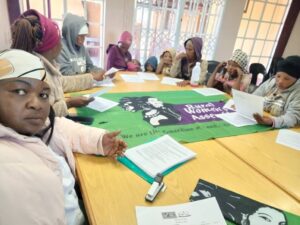
This year, as the world commemorates Women’s Month, rural women in Lesotho have chosen to celebrate not only with words but with concrete action. Through the hope for rural women assembly, we marked this important month by planting trees across our villages, conducting training sessions on beekeeping, and on land and environment with the ministry of Agriculture. This activities were designed to remind us, as women, of our vital role in protecting the planet and ensuring sustainable livelihoods for our families.
Tree planting became the centre piece of our celebration. In a country like Lesotho, where climate change has worsened droughts, soil erosion, and unpredictable weather patterns, trees are more than just plants, they are life givers. By planting trees, we contribute to restoring degraded land, providing shade, attracting rainfall providing sustainable energy for cooking and improving air quality.
For us, rural women, tree planting is also symbolic. It represents growth, resilience, and continuity. Many of us depend on the land to survive, whether through farming, fuel wood collection, or small household gardens. By investing in trees, we are investing in a sustainable future for our children and grandchildren.
As we put the seedlings into the soil, we reflected on how women are the first ones to feel the impacts of climate change. When the rain falls, it the women who walk long distances to fetch water. When crops fail it is the mothers struggle to feed their families. Planting trees during women’s month was therefore not just about climate change, it is about reclaiming our power to shape solutions.
Alongside tree planting, we also organized training on beekeeping. Bees play a crucial role in our ecosystems by pollinating crops and wild plants, yet their populations are declining due to habitat loss and chemical use. Training women on bee keeping therefore serves two purposes: protecting biodiversity and creating sustainable income.
During the training we learned about the basics of managing bee hives, harvesting honey, and ensuring that bees thrive in healthy environments. For many women, the idea of producing honey and beeswax opens new economic possibilities. Honey is not only nutritious food but also a product that can be sold in local markets, contributing to women’s financial independence.
Bee keeping also ties directly to climate action. Healthy bee populations support food security, making farms more resilient to changing weather patterns. For us, this training was an eye opening reminder that solutions to climate change are not only about large projects, but also about small local practices that improve both the environment and livelihoods.
The second training focused on land and environment, two issues that remain deeply connected to women’s struggles in Lesotho. Land is a foundation of rural life, yet women still face the barriers of ownership and decision making under statutory systems. This lack of control leaves women vulnerable, especially in times of environmental stress.
In our training, we discussed how to use land sustainably, protect soils from erosion, and prevent overgrazing. We also shared knowledge on how climate change affects our land and what actions we can take as communities. Most importantly, we created space to reflect on women’s rights to land. Without secure access to land, rural women cannot effectively implement climate-smart farming, tree planting, or conservation practices.
Our celebrations during Women’s Month reaffirmed what we already know that rural women are not passive victims of climate change. We are leaders, knowledge holders and solution makers. Planting trees, keeping bees and learning about land and environment are more than activities, they are acts of resistance against poverty, inequality and ecological destruction. Through these actions, we are also building solidarity among ourselves. Working together as women strengthens our voices in decision-making spaces, whether at community meetings or national platforms and also we are showing that climate justice cannot be achieved without gender justice.
Looking forward, as we move beyond Women’s Month, the work does not end. The trees we planted must be cared for, the bee hives maintained and the lessons on land and environment put into practice and this is an-going journey, not a one-day celebration therefore we call upon government, civil society and all partners to recognize and support the leadership of rural women. Resources, policies and training opportunities must be directed towards empowering Women to be guardians of the land. After all, when women rise, the whole community rises.
This Women’s month, we celebrated by digging into the soil, caring for bees and deepening our knowledge of the land. In doing so, we honoured not only ourselves but also the generations yet to come. We believe that small seeds of change, whether a tree seedling, a bee colony or a new understanding of land rights, can grow into powerful movements that transform society.
Rural women of Lesotho will continue to stand at the forefront of climate action, proving that true celebration is found in protecting the earth that sustains us all.