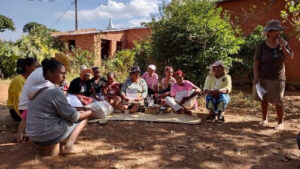
Rural women in Malawi have the potential to play an active role in responding to climate change through community awareness, agroecological practices, and tree restoration initiatives as they are central players in many rural communities. This is what drives the tree planting initiative led by the Rural Women’s Assembly (RWA) Malawi. The focus on tree planting is particularly important in Malawi, where charcoal and firewood remain the dominant sources of household energy. The widespread cutting of trees for fuel is a major driver of deforestation and environmental degradation.
RWA members conducted climate change awareness campaigns in Ntchisi, Dowa, Kasungu, and Balaka districts. These campaigns focused on promoting the use of indigenous seeds and mixed cropping systems as natural pest control methods and as strategies for building resilience to climate variability. The approach emphasises reduced reliance on chemical inputs while improving soil health and crop diversity. In addition, RWA Malawi organised a climate change workshop for rural women to highlight how climate variability continues to threaten food systems and small-scale agriculture. The workshop emphasised the importance of adapting and preserving local seed varieties as a way to reduce chemical use and mitigate climate change impacts. Women were encouraged to apply agroecological practices that strengthen food security and household resilience.
To support reforestation efforts, poly tubes were distributed to Ntchisi, Phalombe, and Chiradzulu districts to establish tree nursery beds. The nurseries are expected to supply seedlings for planting in January next year. Ntchisi district currently has 5,000 tree seedlings in its nursery, with a target of reaching 20,000 trees nationwide once seedlings from Phalombe and Chiradzulu are added. RWA Malawi is also implementing the “1 Woman, 20 Trees” initiative, which encourages each woman to plant and care for at least 20 trees. In Ntchisi, 221 women are already participating, with an additional 100 or more women involved in Phalombe and Chiradzulu. The initiative aims to restore tree cover, reduce pressure on forests, and strengthen women’s understanding of climate change and environmental protection. By planting trees and promoting agroecological practices, RWA Malawi seeks to ease pressure on forests, improve carbon sequestration, and support sustainable livelihoods.
“In Ntchisi we’ve just set up 8 demo plots, these are the very first ones for this season and we’ve already spread manure on them and laid out box ridges,” said Emily. “This is part of the broader climate change awareness drive that’s running across the country and women in different districts are geared for change.By planting these trees and promoting agro ecology, we’re easing pressure on forests, locking carbon and building a strong women led force that truly grasps climate change.”
Through community education, tree planting, and agroecology, RWA Malawi are contributing to climate change mitigation while strengthening food systems and local resilience.