
Day Two of the Rural Women’s Assembly Consultative Dialogue began with reflection. After a first day filled with seed stories, policy debates and practical agroecology learning, participants returned to the room carrying the questions that had stayed with them overnight. They reflected on the distance between policies and people, between government promises and the realities of women farming in dry fields, flood-prone communities and places where land, water and resources remain out of reach.
One message came through strongly: rural women are already doing the work of building resilient food systems. The question is why the systems meant to support them continue to leave them behind.
The morning opened with sisters sharing what Day One had meant to them. Women from across the region spoke about the importance of indigenous seeds, agroecology, youth involvement and policy participation. They also returned to the question that had unsettled the room the day before: why are the people producing food and protecting biodiversity still excluded from agricultural budgets, climate financing and decision-making spaces?
For many, the answer was not simply about a lack of money. It was about power.
Climate Change Is Real, but So Is Climate Injustice
Read the Voices from Below: Affected Women Speak Out on the Climate Crisis where sisters shared real-life experiences with the climate crisis.
Dr. Million Belay of the Alliance for Food Sovereignty in Africa brought this truth into sharp focus during his presentation on climate, agroecology and resilience. He reminded participants that Africa contributes only a small share of global greenhouse gas emissions, yet communities across the continent are among those facing some of the harshest consequences of climate change. Droughts, floods, cyclones, heatwaves and changing rainfall patterns are daily realities that destroy crops, wash away seed, kill livestock, deepen hunger and make already difficult livelihoods even harder. But Million challenged the idea that climate change is only an environmental problem. It is also a question of justice. It is a question of whose knowledge is valued, whose voices shape policy and who receives support when disaster strikes. Women farmers, he explained, are already protecting biodiversity, conserving seed, strengthening local markets and feeding communities through agroecology. Yet the solutions they practise are still often treated as small, informal or secondary, while expensive technical interventions and large-scale projects receive the funding.
The room listened closely as he asked why the people who are most affected by climate change receive so little of the money meant to support adaptation. For rural women, this was not an abstract question.
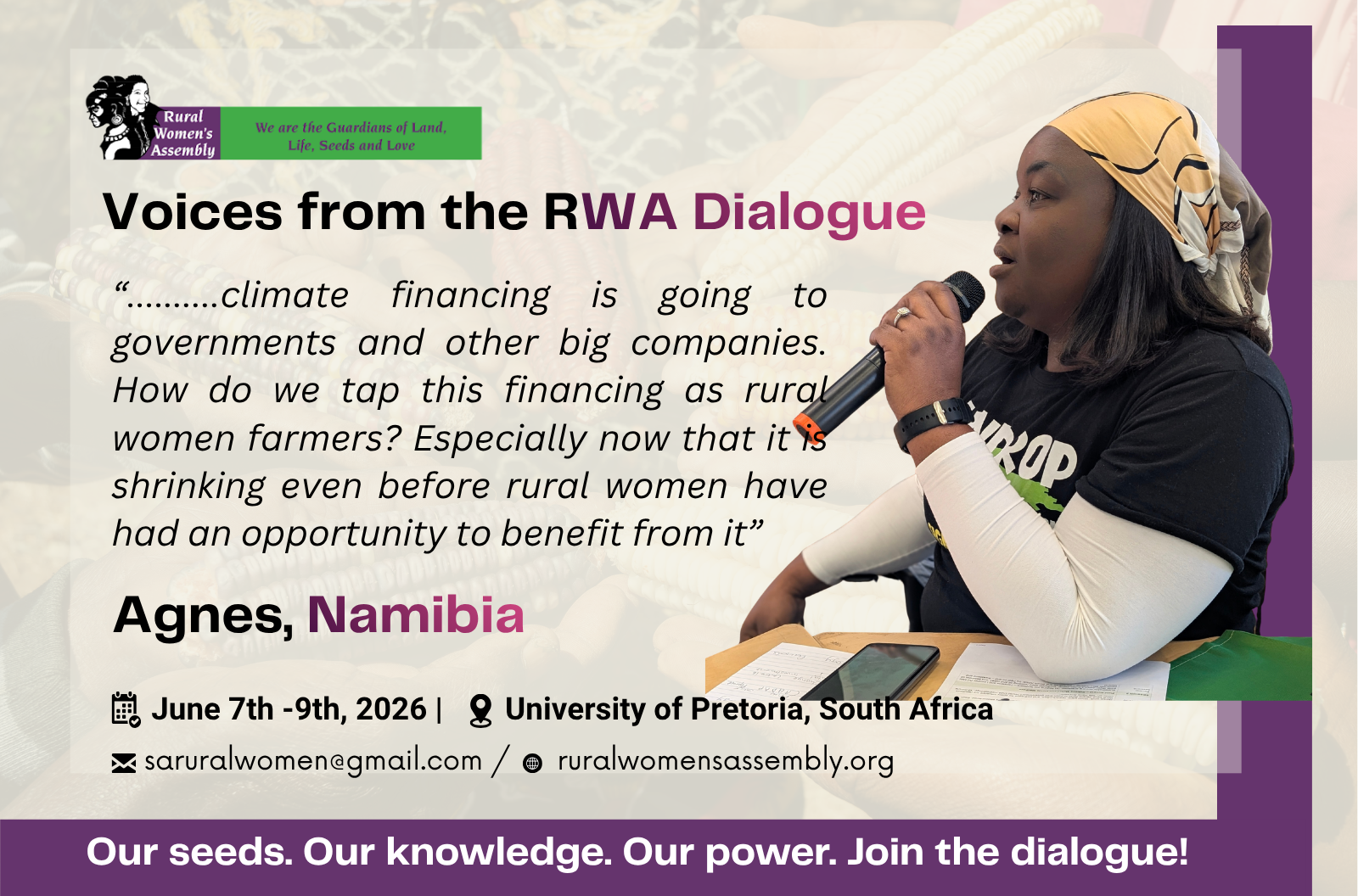
Susan from RWA Zambia and Agnes from RWA Namibia asked directly: “You told us climate financing is going to governments and other big companies. How do we tap this financing as rural women farmers? Especially now that it is shrinking even before rural women have had an opportunity to benefit from it”
Their questions carried the frustration of many participants in the room.
Climate finance is often discussed in global meetings, national plans and government reports. Yet for women on the ground, that money rarely reaches the fields where crops have failed, the homes where food is running out or the communities rebuilding after floods and cyclones. The dialogue made it clear that climate finance cannot continue to move only through governments, corporations and large institutions while rural women are expected to survive climate shocks through their own labour, seed systems and community solidarity.
Agroecology Is More Than Farming
The conversation also returned to agroecology.
For RWA sisters, agroecology is a way of protecting life. It means growing diverse crops instead of relying on a single crop. It means using local seed that is adapted to local conditions. It means restoring soils, conserving water, reducing dependence on costly fertilisers and pesticides, and strengthening the knowledge that communities already hold. It also means building independence. When farmers depend on imported seed, fertiliser, chemicals and global supply chains, they become vulnerable to rising prices, war, market shocks and corporate control. The COVID-19 pandemic and the war between Russia and Ukraine showed how quickly these systems can break down. But when communities have their own seeds, local markets, shared knowledge and agroecological production, they are better able to withstand crisis. Still, the dialogue did not ignore an important warning: agroecology itself can be taken over by institutions and companies that remove its political meaning.
Dr Boaventura Monjane reminded participants that agroecology must not become another label used by agribusiness while rural women remain without land, water, rights and power. He stressed that the agroecology RWA is fighting for is peasant agroecology, rooted in justice, collective power, food sovereignty and control over the means of production.
This is why the dialogue kept returning to one central truth: there can be no climate justice without agrarian justice.
Why Alternatives Require Support: Funding Women’s Solutions, Not Just Projects
The afternoon turned attention to funding, policy and the difficult reality of building alternatives in a system designed to favour industrial agriculture. The panel brought together a diverse mix of movement leadership, policy analysis, regional experience and funding perspectives.
Beatrice Makwenda from RWA Malawi spoke about the need to move beyond funding short-term activities and begin funding the institutions, movements and women’s leadership that can create lasting change. She challenged donors and governments to ask why agroecology is widely spoken about, yet still receives so little meaningful investment.
Dr. Stephen Greenberg shared a regional policy perspective, warning that Southern Africa remains behind in developing strong agroecology frameworks and that reliance on foreign aid is becoming increasingly uncertain. He urged the movement to use available policy spaces strategically while also building its own regional advocacy power.
Aktofel Amalunga, a government official from Namibia brought practical policy experience, speaking to the need for rural women to engage national and regional agricultural frameworks, including the CAADP focal points in their countries, so that implementation is not left to governments alone.
The call from the room was clear: fund leadership. Fund organising. Fund institutions. Fund the work that rural women are already doing. Rural women do not need another project that arrives, distributes inputs and disappears after two years. They need resources that help them build seed banks, strengthen local markets, train young people, secure land and water, document their knowledge, advocate for policy change and sustain their movement across generations.
Why Alternatives Require Support: A Conversation with Funding Partners
Funding partners also shared reflections on the kind of support that is needed. The conversation pushed back against funding models that prefer short pilot projects, technical fixes and narrowly defined activities. Sisters argued that these approaches often leave communities dependent, while failing to build the long-term strength of movements. The donor session moved the dialogue from a familiar question, why are rural women’s solutions underfunded?, to a more urgent one: what kind of funding is needed to sustain them?
The discussion brought together funding partners, movement leaders, academics and policy practitioners to reflect on the gap between the growing recognition of agroecology and the limited resources reaching the rural women who practise it every day. Across the room, there was agreement that women-led agroecology cannot survive on short-term projects, scattered pilot initiatives or funding that arrives with conditions that do not match community realities.
Rafeenway Jawna from the Rosa Luxemburg Foundation spoke about the danger of funding approaches that favour technical fixes while ignoring social justice, land rights, labour rights and the political power of small-scale farmers. She noted that climate funding often supports forms of regenerative agriculture that do not challenge the deeper inequalities in food systems. Her contribution raised an important question for the dialogue: “What public investment and policy support are needed to ensure that agroecology remains rooted in justice rather than being absorbed into agribusiness language?”
Lucy from We Effect reflected on the importance of long-term support for grassroots movements. She explained that the organisation’s support is shaped by a commitment to movement building, allowing partners such as the Rural Women’s Assembly to develop their own strategies, policies and visions for change. At the same time, she warned that changing aid priorities in Europe are making this support increasingly uncertain, as governments link development assistance more closely to trade and business interests.
For the rural women in the room, this concern was not new. They have seen projects come and go, often leaving little behind once funding ends. The conversation therefore called for a shift away from funding isolated activities and towards supporting institutions, movements and women’s leadership over the long term. Beatrice Makwenda from RWA Malawi challenged funders and policymakers to look beyond the language of transformation and ask whether funding systems are truly accessible to rural women. She argued that women are already building resilient food systems, but public and philanthropic funding rarely reaches them at the scale, speed and flexibility needed. “Can we catalyse long-term support for the movements, not just pilots?” she asked.
Dr. Stephen Greenberg added a regional perspective, warning that agroecology funding remains fragile and can easily be sidelined when national budgets tighten or donor priorities shift. He encouraged the movement to build its own regional advocacy strength, map funding opportunities and engage policy frameworks such as CAADP, the African Union’s soil health agenda and SADC processes with a clear agroecology agenda.
The discussion also highlighted the need for governments to create dedicated budget lines for agroecology, farmer-managed seed systems, local food markets, women’s access to land and water, and community-led adaptation. Rather than relying only on external support, participants stressed that public resources must be redirected towards the women who are already feeding communities, conserving biodiversity and responding to climate shocks.
The session closed with a clear call: rural women do not need more temporary projects that distribute inputs and disappear. They need sustained investment in seed banks, agroecology learning, local markets, value addition, organising, youth engagement and policy advocacy. They need funding that trusts their knowledge. They need support that strengthens their institutions. And they need investment that helps them build the food systems they already know are possible.


