
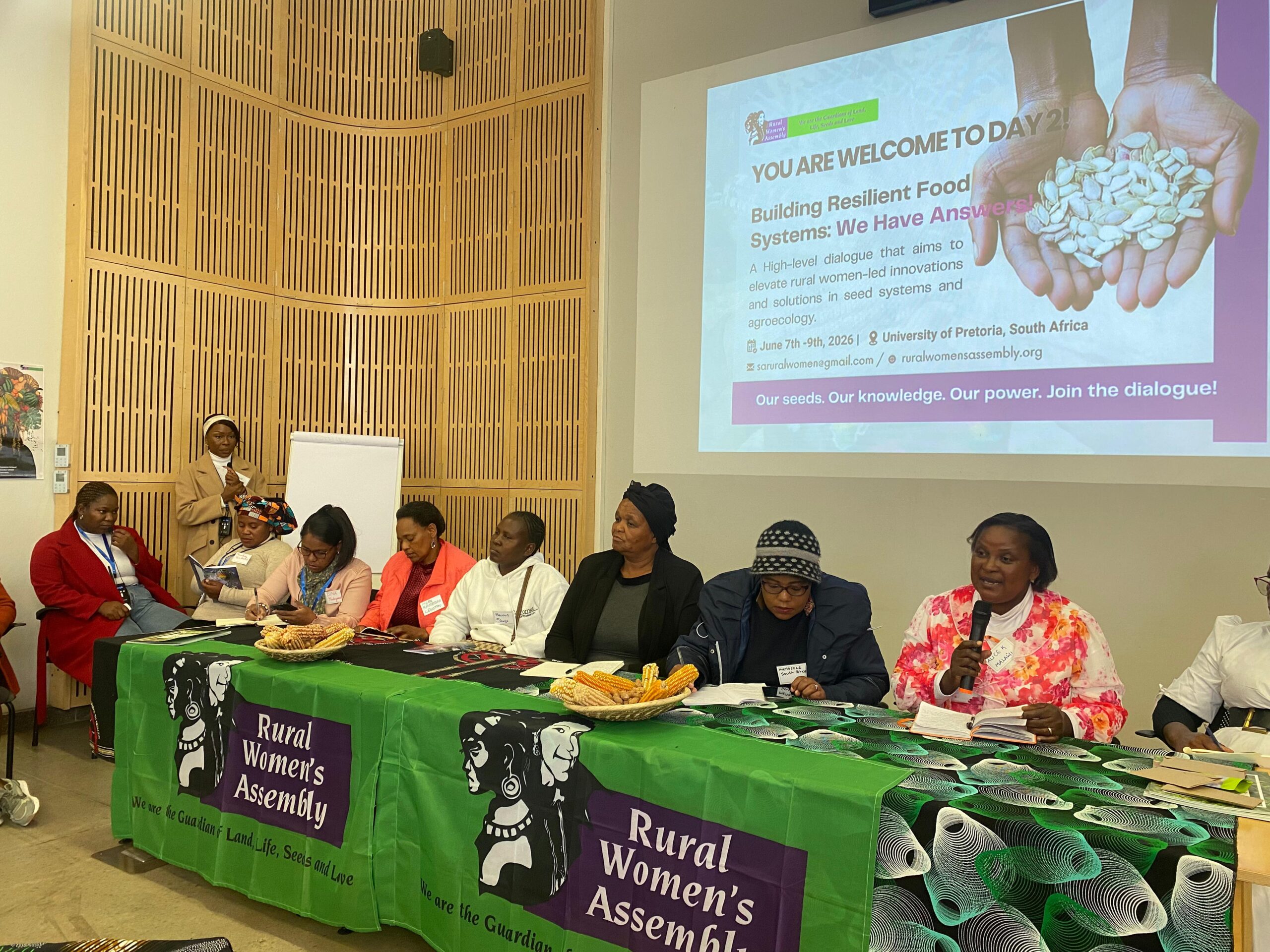
The climate speak out brought the dialogue back to the lived realities behind the words “climate adaptation,” “resilience” and “food insecurity.” One by one, sisters from across Southern Africa stood to speak about crops lost, fields flooded, livestock dying, seed disappearing, water sources drying up and families struggling to survive. The countries were different. The rainfall patterns were different. The languages, landscapes and farming systems were different. Yet the stories met each other in the same place: rural women are carrying the heaviest burden of climate change while remaining excluded from the resources and decisions meant to address it.
From Malawi came the story of women who are expected to produce food, collect water and care for families even as droughts, floods and unexpected storms shorten growing seasons and deepen food insecurity. Women and girls are walking longer distances to fetch water, often losing time for school and increasing their vulnerability to early marriage and gender based violence. Yet RWA Malawi is responding through agroecology demonstrations, community seed banks, village savings groups and the planting of 12,000 trees across three regions. Their demand was clear: “We sing this song every year, every day, about climate finance.”
In Eswatini, sisters spoke of a season that began with late rains, followed by heatwaves that scorched crops, and then heavy rains and storms that destroyed what had survived. Without an agroecology policy or reliable early warning systems, women have had to build their own responses. They established sixteen agroecology plots, encouraged women to keep four or five seed varieties in their seed banks and shifted to legumes and sweet potatoes after storms so families could still barter for food. “We have overcome challenges; after heavy storms, we shifted to plant legumes and sweet potatoes in the fields so women can barter.”
In South Africa, Mamasole described the combined impact of drought, heatwaves, fires and floods, with communities left without meaningful support after disasters. She spoke of the urgent need for access to land with water so women can expand their seed multiplication sites. Even under these conditions, women continue to grow diverse crops, practise agroforestry and build shade into their farming systems to protect production. “We grow diverse crops to enhance resilience. We do agroforestry where we integrate shade to our farming.”
From Zambia, Bridget spoke as a small-scale farmer whose country had faced widespread hunger and food insecurity. Emergency support was inadequate, and in some cases only households with men could access food for work programmes. She challenged the Farmer Input Support Programme for promoting corporate inputs such as maize, soya beans and chemical fertiliser while failing to support value addition, diverse local crops and women’s livelihoods. RWA Zambia is responding through diversified seed planting, agroforestry and gender based violence programmes. “If we plant a lot of seeds, we won’t be hungry. We can eat maize, millet and sorghum.”
In Zimbabwe, Patronella spoke of floods washing away ridges, storms destroying roofs, drought destroying crops and livestock suffering alongside women’s shattered hopes. She questioned promises of climate adaptation that rural women rarely see in practice, particularly when support is limited to small quantities of hybrid seed and chemical fertiliser. Yet women are still building seed banks, raising awareness on agroforestry and practising agroecology across provinces. “We only hear about climate adaptation, but we are not seeing it.”
Mary from Lesotho described shifting seasons, late and extreme rainfall, drought, crop failure and animal deaths that lead directly to malnutrition. She also showed how climate vulnerability is shaped by unequal land rights, with men controlling land while women carry the consequences when production fails. Accessing seed subsidies is made difficult by costly travel, complicated paperwork and requirements that many rural women cannot meet. Still, RWA Lesotho continues to share information, promote crop diversity and engage the Ministry of Agriculture. “We have to proceed in producing variety.”
In Madagascar, Dina spoke about repetitive cyclones, floods, heavy rains and water shortages that are reducing harvests and making it harder for women to feed their families. She explained that many women lack the funds, tools and materials needed to strengthen their work, even though their traditional practices are part of the response to climate change. RWA Madagascar continues to practise agroecology, preserve seed and share knowledge among women despite limited resources. “We do our best to share the knowledge we have amongst ourselves.”
From Mozambique, Trumha described a country facing prolonged wildfires, drought, water shortages and destructive cyclones that wipe out production, homes and even lives. Women are especially vulnerable because they are responsible for food production and household survival. Yet RWA Mozambique is mobilising communities to farm differently in changing seasons, producing in low lying areas during drought and moving to higher ground during floods. “In drought seasons we produce in low areas and in flood seasons in high areas.”
In Namibia, Olivia spoke about water scarcity, dependence on rainwater, unpredictable rainfall, floods, pests and diseases that are destroying food and livelihoods. She also raised concern about land being lost to new development, weak support from government and civil society, and the gradual loss of indigenous seeds. Still, women are establishing agroecology plots, engaging government officials and running campaigns on food prices, women’s empowerment, agroecology and gender based violence. “Water scarcity is the main challenge.”
From Tanzania, Manana described the double burden of floods and drought, alongside limited access to organic fertiliser technologies, agroecology training, capital and meaningful participation in decision making. Yet the sisters also shared a significant achievement: the government had allocated seven acres of land to the Rural Women’s Assembly for farming and seed banking. “Our government gives us, the Rural Women’s Assembly, seven acres to grow. They are helping us to build our seed banking.”
From Mauritius and Rodrigues, Mirella spoke about cyclones, drought, water shortages and torrential rains that destroyed crops in March. Her testimony showed that island communities are also carrying the impacts of climate instability, with rural women responding by strengthening organisation from below. “The solutions we are providing, from the working class movement, is setting up a Rural Women’s Assembly in Rodrigues.”
Together, these testimonies showed that climate change is not arriving as one disaster. It comes as drought followed by floods, heatwaves followed by storms, seed loss followed by hunger, and rising pressure on women who are already responsible for feeding families and holding communities together. The Climate Speak Out, aside from bringing out the evident loss experiences due to the climate crisis across the region also showcased the ways women are responding with little support: saving and sharing seed, planting trees, establishing agroecology plots, diversifying crops, practising agroforestry, adapting planting locations, forming savings groups, building seed banks and organising collectively.
Rural women are not asking to be praised for resilience while being left alone to survive climate crisis after climate crisis. They are asking for land with water, recognition of their knowledge, access to seed and technology, public investment in agroecology, disaster preparedness, direct climate finance and a real place in the decisions that affect their lives. Because when the rains fail, when the rivers rise and when the fields are destroyed, rural women are still the ones who plant again.


