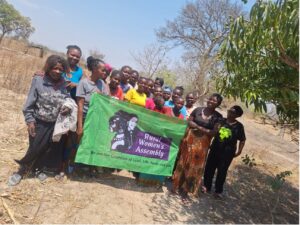
Across Lesotho, rural women are rising to reclaim what is rightfully theirs—land, seeds, and a voice in shaping the future. In the face of climate change, exploitative seed systems, and a land tenure system rooted in patriarchy, women are organizing, educating, and resisting.
“The two laws used in the country are contradictory,” say rural women from across Lesotho. The country operates under both statutory and customary law, but in most rural communities, it is customary law—administered by local chiefs—that dominates daily life. This form of law continues to marginalize women, denying them inheritance rights, land ownership, and participation in local decision-making bodies.
Mme Mamaimenyane at a recent land tenure workshop shared, “We are the ones most affected. Chiefs decide everything without women. Customary law denies us inheritance, land ownership, and decision-making.”
She even shared her story that she was married to her late husband in customary law, after his death she wanted to register their land and property in her name, she was told she couldn’t do that because if she gets married it means she might go the new family with the property and leave the children with nothing, but she should rather register it in one of her sons name.
Women are now demanding that the government adopt a unified legal system, one that is inclusive, just, and that explicitly recognizes women’s rights to own and inherit land, as well as participate fully in decisions that affect their families and communities. They say even if they want to change their marriage from a customary one to statutory the husbands don’t want to because they say they want to control the household and want to be the men of the house. Women also say that because they are the caretakers of the families land is essential for them in order to be able to produce food without having to ask the husband to give them authority on what they can plant in the field, because of the growing cannabis plantation in the countrymen are prioritizing it and forgetting that their families depend on maize, sorghum and beans for their everyday survival, most of the fields used for cannabis growing are rented which means the family will have to go and buy maize meal
Traditional seeds, once abundant, are now disappearing from local fields and markets. These indigenous seeds are climate-resilient, more affordable, and well-suited to local conditions, yet they are not promoted by extension services or made available in seed shops. Instead, hybrid and genetically modified (GMO) seeds which are often costly and unsustainable are prioritized.
Women farmers are advocating for policies that recognize the importance of local seed systems. “We are calling on the government to include local seeds in seed shops and create seed banks for future generations,” declared one participant at a recent central meeting.
These women are also exchanging seeds amongst themselves and passing on seed-saving knowledge to younger generations. Such efforts are essential for food sovereignty and ecological resilience.
This winter, Lesotho has experienced unusually heavy snowfalls, with devastating consequences for rural families. Sheep have perished, travel has become dangerous, and access to critical services is disrupted. Most people in these areas have no insurance to cover these losses.
Women—who are the primary caregivers and small-scale farmers—are hardest hit. They walk long distances to fetch water and firewood, care for livestock, and manage food supplies during weather disruptions. Yet their voices remain largely unheard in climate policymaking spaces.
It is clear that the climate crisis is not gender-neutral. Any solutions must be developed with and by women, recognizing their knowledge, labor, and leaders.
During a recent feminist school held in Swaziland, rural women from across the region came together to explore the intersections between patriarchy, capitalism, and environmental destruction. From that experience, a shared vision emerged: that the fight for gender equality is inseparable from the fight for climate and environmental justice.
Ecofeminism recognizes that the same systems that exploit the Earth also oppress women. In Lesotho, this is evident in the denial of land rights, the sidelining of traditional farming systems, and the neglect of women in climate policy and resource distribution.
Rural women are not waiting for permission to lead. They are already reclaiming their role as guardians of land, water, and seeds building alternatives rooted in care, community, and sustainability.
Call to Action
To support this movement, we call on citizens, policymakers, and civil society to:
– Demand a single, unified legal framework that guarantees women’s land rights.
– Protect and promote local seeds through national policy and public agricultural programs.
– Recognize and include rural women in all climate-related policymaking and planning processes.
– Support the creation and funding of community seed banks.
– Advocate for gender-responsive disaster response and climate adaptation programs.